Choi Hong Hi Art of Self Defense First Edition
Choi Hong How-do-you-do's plaque at Taekwondowon
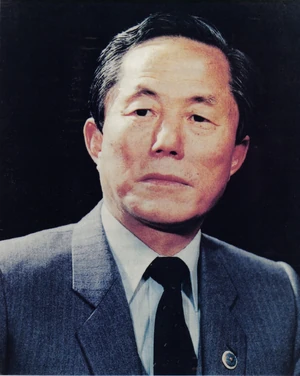
CHOI, Hong-hi (Nov 9, 1918 – June 2002), also known every bit General Choi, was a S Korean army general and martial creative person who is in many circles regarded every bit the "Founder of Taekwondo." Choi is arguably the nigh controversial figure in taekwondo history.
- In ITF-style taekwondo, Choi is widely celebrated as the founder of taekwondo.
- In Kukkiwon/WT-mode taekwondo however, Choi's contributions to taekwondo history are somewhat more downplayed.
When writing about the history of modernistic taekwondo, the two major styles of taekwondo (ITF and Kukkiwon/WT) tell the story rather differently. Most WT source do non explicitly say that Choi did annihilation dishonorable (though that it sometimes intimated); instead they merely downplay his role.
Contents
- one Context of the Controversy: The Cold War
- i.i Further Reading:
- ii Biography
- 2.1 Education
- 2.2 Professional Experience
- ii.3 Publications
- 3 Encounter Likewise
- iv References
Context of the Controversy: The Common cold War [ ]
I reason it's difficult to tell the story of Full general Choi is considering of the political context of the times. Taekwondo was developed during the most intense period of the Cold War.
- Prc was, of course, a communist country at that time (and all the same is, though information technology has undergone many economic reforms in recent decades).
- Likewise, North korea, supported by the Soviet Union and by People's republic of china, was (and still is) also a communist land at that time. Retrieve that during the Common cold State of war, in the days of McCarthyism, being called Communist was a severe accusation non merely in the U.S. but in many other parts of the world as well.
- Japan had just been defeated in World War II, ending 5 decades of cruel imperialistic practices in Asia. Equally but one example, during Japan's 35 year occupation of Korea, Nippon forced hundreds of thousands of young Korean women ("Comfort Women") to serve equally sexual slaves for members of the Japanese Imperial Army. In the early days of the Cold War, despite Nihon'due south mail-war reforms, Korea'southward memory of Japanese Royal cruelty was still bitterly fresh.
- S Korea, though it flirted occasionally with modern liberal democracy, was primarily a military dictatorship for most forty years, from about the early 1950s until 1987. During the Cold War, Republic of korea was nominally an ally of the Us, just just because South Korea was staunchly anti-Communist at a time when Communism was seen in the West as the earth'south greatest threat to peace and stability.
In other words, from the standpoint of international relations in that part of the world, there were no "good guys" among the nations surrounding Korea at the time of the invention of taekwondo. That role of the world was a mixed handbag of communism, dictatorships, and as well-recent imperialism.
In this context, we have General Choi, a man who made it his life's passion to invent a new, uniquely Korean martial art (taekwondo) and promote its adoption worldwide. In lodge for Choi to succeed, he would need both funding and political support.
- If he sought funding or support from Democratic people's republic of korea, he'd exist branded a Communist, which at that time in Republic of korea (and elsewhere) was viewed as traitorous, illegal and severely punishable.
- To seek funding from Southward Korea, he'd accept to at least tacitly support a armed services dictatorship.
In fact, the South Korean authorities itself did want to promote taekwondo worldwide:
- Promoting taekwondo as a new international sport would lend much needed credibility to Due south Korea on the international stage.
- And also, past some counts, the Korean version of the CIA (called the KCIA) sought to employ the many taekwondo schools effectually the earth to pursue its ain covert agendas.
To be fair, ane could make a potent argument that Choi was caught between a stone and a difficult place. His ain calendar (promoting his version of taekwondo worldwide) required funding and political back up, but the just sources of major funding and political support bachelor were from either a communist government or a war machine dictatorship. Past all accounts, Choi did at least explore the possibility of accepting back up from North Korea (going so far as to travel there during the height of the Cold War); that lonely would tarnish him equally a traitor for those who at the fourth dimension were staunchly anti-Communist.
From the standpoint of the South Korean government (then still a military dictatorship) the solution to this problem was to develop an entirely new class of taekwondo that was contained of Choi. The new form of taekwondo is what we at present call Kukkiwon-style (or WT-mode) taekwondo. The mode of taekwondo that Choi himself had already successfully spread around the world (despite the many obstacles) is what we now call ITF-manner taekwondo.
Now in the 21st Century, when both Southward Korea and Japan have been liberal democracies and skillful Western-allies for decades, when even China has adopted many gratis market principles and trades freely and extensively with the U.S. and the W, it is perhaps difficult to remember that the nascent years of taekwondo were played out in a globe that was very unlike from the world we live in today. It is incommunicable to capeesh the life or accomplishments of General Choi without keeping that in heed. It is likewise difficult to know – fifty years later – how much of what is said near Choi is true, and how much is conjecture. Any pupil of taekwondo history, however, has to acknowledge that Choi's early contributions to taekwondo and to the adoption of taekwondo worldwide were extremely meaning.
Farther Reading: [ ]
- Read about the Japanese occupation of Korea on Wikipedia http://en.wikipedia.org/wiki/Korea_under_Japanese_rule
- Read about Comfort Women on Wikipedia http://en.wikipedia.org/wiki/Comfort_women
- Read about the Cold War history of S Korea (including its military dictatorships) on Wikipedia: http://en.wikipedia.org/wiki/History_of_South_Korea
- Read about the KCIA on Wikipedia http://en.wikipedia.org/wiki/KCIA
- For a detailed and extremely well-researched business relationship of this menses, see "A Killing Art: The Untold History of Tae Kwon Do" past Alex Gillis
Biography [ ]
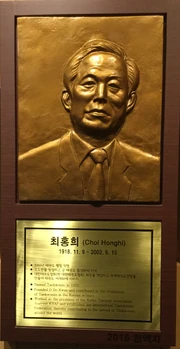
Choi Hong Howdy'southward plaque at Taekwondowon
Choi was born on 9 November 1918 in Hwa Dae, Myŏngch'ŏn county, in what is now North Korea, which at that fourth dimension was nether Japanese rule. At age 15, Choi's male parent sent him to written report calligraphy under Han Il Dong, who was likewise said to exist "a master of Taek Kyon, the aboriginal Korean fine art of foot fighting."
In 1938, during his high school years, Choi relocated to Japan to report. But before Choi left Korea for Nippon, Choi had a gambling disagreement with a large and intimidating wrestler named Hu, and the possibility of a future confrontation inspired Choi to railroad train in martial arts; in his own words, "I would imagine that these were the techniques I would utilize to defend myself confronting the wrestler, Mr. Hu, if he did attempt to bear out his promise to tear me limb from limb when I eventually returned to Korea." In addition to his academic studies, Choi studied Shotokan Karate while in high school and recieved his 1st dan rank nether a Korean instructor named Kim Hyun-Soo. Choi then attended to Chuo University in Tokyo where he connected to train in Shotokan Karate, reportedly receiving his 2nd dan rank before graduation. (Shotokan founder Gichin Funakoshi sometimes taught at Chuo University during this timeframe, and then it is commonly believed that Choi probably received at to the lowest degree some pedagogy from Funakoshi during this time.) Choi graduated from Chuo University in 1943, and taught karate for a curt time at the Tokyo YMCA.
Like many young men during the Japanese occupation, Choi was conscripted in October 1943 and forced to serve against his will in the Japanese Imperial Army during World State of war Two. Choi was posted to Pyongynag where he became involved in the Korean Independence Motility. Choi was implicated in a rebellion confronting his Japanese commanders nonetheless and was imprisoned by the Japanese. At the stop of Globe War II, Choi and the other prisoners were of course released. The post-state of war division of Korea between North and South, however, left Choi unable to return to the land of his nascence in the northward. Instead, Choi joined the South Korean army in 1946. Past 1951 he had been promoted to brigadier full general, and by 1954 to major general.
Choi believed that the new Southward Korean army would do good profoundly from martial arts training. He felt strongly, nonetheless, that Korea should develop a uniquely Korean martial art to teach to its troops (rather than teaching Japanese karate to Korean troops). During the Korean State of war, Choi created an officer training program and an infantry division that provided martial arts instructors to the war machine. As ane of the inventors of taekwondo, much of Choi's energies during his life were devoted to making taekwondo be distinct from karate in terms of its forms and techniques. Choi was ultimately successful at the widespread adoption of taekwondo in the Korean armed forces, and in fact many U.Due south. servicemen stationed in Korea first learned taekwondo in that location before bringing taekwondo dorsum to the U.South.
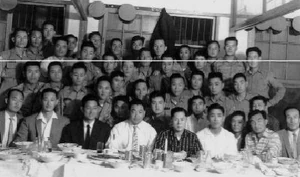
Nam Tae Hi, quaternary from left on the bottom row, sits next to Choi Hong Hi, fifth from left.
In 1959 Choi was named President of the Korean Taekwon-do Clan (KTA), the organization chartered with bringing the Nine Kwans together to form a mutual Korean martial art. In 1962, Choi was sent to Malaysia equally Southward Korean administrator, but later on his return to South Korea in 1965 he establish life under the Due south Korean regime so intolerable that past 1972 he finally emigrated to Canada. During the 1960s, Choi and Nam Tae Hi led the original masters of taekwondo in promoting their martial fine art effectually the world. In 1966, Choi created the International Taekwon-exercise Federation (ITF). Choi'due south commencement English language-language manual, Taekwon-Do (1965), eventually led to the publication of an entire taekwondo encyclopedia on the art in 1985. In 1973, shortly after Choi's emigration to Canada, the Southward Korean government promoted the Kukkiwon and subsequently the WTF. From his new dwelling house in Canada, Choi connected however to promote ITF-style taekwondo worldwide. He continued in this endeavor throughout the remainder of his life.
Choi died of cancer on fifteen June 2002 in Pyongyang, Democratic people's republic of korea. Before long afterward his death, the ITF split into three split organizations (see ITF Taekwon-do for an explanation of the split).
Choi is listed in the Taekwondo Hall of Fame with various titles: "Father of Taekwon-Do," "Founder and First President of the International Taekwon-Exercise Federation," and "Founder of Oh Do Kwan." Choi's obituary from the 8 August 2002 New York Times reads as follows:
-
- Gen. Choi Hong Hi, widely best-selling equally the founder of tae kwon do, a martial art that began in Korea and spread rapidly to customs centers and storefronts around the Us, died on June xv in Pyongyang, North Korea. He was 83 and lived in Mississauga, Ontario, a suburb of Toronto.
-
- General Choi went home to dice in Pyongyang after doctors in Canada determined his tummy cancer was inoperable, said Craig Stanley, an assistant to Jung Hwa, the general's son.
-
- Tae kwon do was developed by General Choi in the 1940's every bit a combination of a Korean form, taek kyon, and the Japanese subject karate. It is a method of unarmed combat intended for self-defense force that engages the mind and the torso.
-
- General Choi's detractors, including officials in the South Korean government, say that the discipline is merely a repackaging of old Asian martial arts techniques. Merely even they credit Full general Choi with the name tae kwon do -- tae, meaning to kick with the foot, kwon, pregnant to strike with the fist, and do, significant art. He came upward with information technology in 1955.
Education [ ]
- Fort Bliss, Texas Army Modern Weapons Course
- Fort Benning, Georgia Army Advanced Infantry School – Military Strategies/Intelligence
- Fort Riley, Kansas Regular army General Ground School – War machine Intelligence
- First Class Graduate of the Commonwealth of Korea'due south Military Academy
- Chuo University Police force School, Japan
- Honorary Doctorate Degrees Earned: Physical Educational activity - Russia 1992, Sports Scientific discipline - Democratic People'due south Republic of Korea 1999, Philosophy - Moldova 2001
Professional Experience [ ]
- President International Martial Arts Games Committee - 1999
- Honorary President Korea Taekwon-Do Association - 1969
- Founding President International Taekwon-Exercise Federation - 1966
- Republic of Korean Ambassador-At-Large - 1965
- President Korea Tae Soo Do Clan - 1965
- 1st Korean Ambassador to Malaysia - 1962
- President Korea Taekwon-Practice Association - 1959
- Director Martial Arts Department Korean Army - 1959
- Founder Oh Do Kwan – Honorary Director Chung Exercise Kwan - 1954
- Promoted to 2-Star Major-Full general Korean Regular army - 1954
Publications [ ]
- Moral Guide Book - 2000
- Taekwon-Do and I: 3 Volume Set - 2000
- Condensed Encyclopedia (6 Editions) - 1988
- Encyclopedia of Taekwon-Do: 15 Volume Set (five Editions 1985-2008) - 1983
- Taekwon-Do (6 Editions & ii Reprints 1972-1986) - 1972
- Human Weapon Mag (1st TKD Magazine) - 1969
- Taekwon-Exercise: Korean Art of Cocky Defence (Reprint 2007) - 1965
- Korean Armed forces Taekwon-Practice Manuscript - 1964
- Taekwon-Do Education Manual - 1959
- Military machine Intelligence - 1953
Run across Also [ ]
- Taekwondo History
- Timeline of Taekwondo
References [ ]
- Choi'due south biography on Wikipedia
- Choi'south biography on the Korean version of Wikipedia http://ko.wikipedia.org/wiki/최홍희 (use Chrome browser or Google Translate to read in English)
- "A Killing Fine art: The Untold History of Tae Kwon Exercise" past Alex Gillis
- Numerous other biographies of Choi are available on the Cyberspace, for case:
- http://world wide web.bishopsstortfordtaekwondo.co.uk/section109882_25449.html
- http://www.fightingarts.com/reading/article.php?id=686
- http://www.itftkd.org/?due north=information
- Many videos of Choi are available on YouTube
Source: https://taekwondo.fandom.com/wiki/Choi_Hong_Hi

Post a Comment for "Choi Hong Hi Art of Self Defense First Edition"